






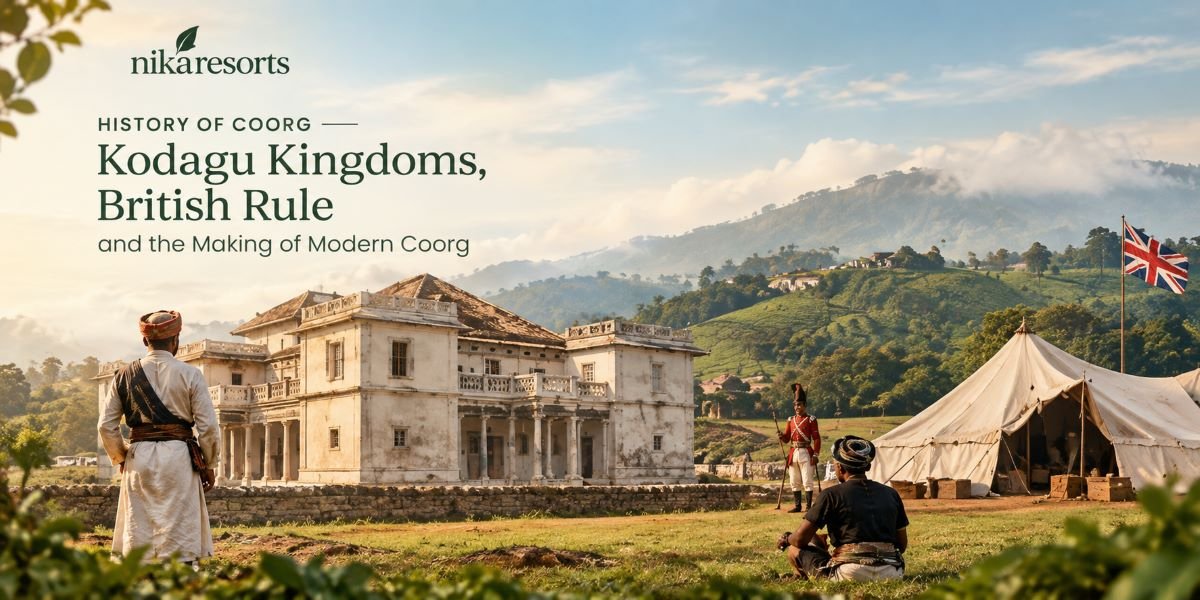
History of Coorg: Kodagu Kingdoms, British Rule and the Making of Modern Coorg
Coorg, officially called Kodagu, is known today for coffee estates, forested hills, waterfalls and the distinctive culture of its people. Yet the landscape visitors see is also the result of a long and complicated history.
For centuries, Kodagu developed as a hill territory with its own chiefs, political institutions and communities. The Haleri dynasty later brought much of the region under a single kingdom. After conflicts with Mysore and changing relations with the British, the kingdom was annexed in 1834. British administration then reshaped agriculture, land management and infrastructure, while coffee became increasingly important to the local economy.
After Indian independence, Coorg briefly existed as a separate state before becoming part of Mysore State in 1956 and, ultimately, present-day Karnataka.
Understanding this sequence makes a visit to Coorg more meaningful. Madikeri’s fort, old settlements, coffee estates and military traditions all connect to different chapters of this story.
Before the Haleri Kingdom: The Early History of Kodagu
Kodagu’s early history is difficult to reduce to a single continuous dynasty. The region came under the influence of several South Indian powers at different periods, while local chiefs exercised authority across its mountainous terrain.
References to Kudagu and related names appear in historical records and inscriptions, although the political boundaries of the area were not always the same as those of today’s Kodagu district.
The geography mattered. The Western Ghats separated Kodagu from the coastal plains, while the eastern approaches connected it with the Mysore region. Forests, steep slopes and river valleys made the territory relatively difficult to control from outside.
Local agricultural communities developed systems suited to the hills, with rice cultivation, forest resources and later plantation agriculture becoming important parts of the regional economy.
The political landscape changed significantly after the decline of the Vijayanagara Empire in the 16th century. It was during this period of shifting regional power that the dynasty later known as the Haleri rulers emerged.
The Haleri Dynasty and the Kodagu Kingdom
The Haleri dynasty became the defining royal house of Kodagu, ruling for more than two centuries until 1834.
The dynasty is generally connected with the Keladi Nayakas, a powerful post-medieval ruling house in Karnataka. Veeraraja is traditionally regarded as the founder of the Haleri line in Kodagu.
Over time, the rulers consolidated their control over much of the territory and developed Kodagu into a distinct hill kingdom.
The dynasty’s importance can still be seen in modern place names and heritage sites.
Why Madikeri Became Important
One of the most significant Haleri rulers was Mudduraja, who moved the capital to present-day Madikeri in 1681.
The town was associated with his name and became known as Mudduraja Keri, which eventually developed into the name Madikeri.
Mudduraja also strengthened the settlement and is associated with the development of its fort. The fort was subsequently modified during later periods, including British rule, so what visitors see today represents several layers of history rather than one unchanged royal structure.
Madikeri’s position also made practical sense. Located in the highlands, it provided the rulers with a defensible administrative centre from which they could exercise authority over the surrounding territory.
Kodagu and the Mysore Wars
The 18th century was one of the most turbulent periods in the history of Coorg.
The expansion of Mysore under Hyder Ali and Tipu Sultan brought the neighbouring power into direct conflict with Kodagu. The relationship involved warfare, territorial disputes and changing political alliances.
Mysore occupied Kodagu for a period between 1780 and 1788. The Kodagu ruler Dodda Vira Rajendra subsequently regained control with British assistance and established a close relationship with the British.
This relationship was important because it changed the political position of the kingdom. In 1790, Kodagu became a British protectorate while retaining its own ruler.
That distinction matters. British influence existed before outright annexation, but the Haleri monarchy continued to govern internally for several decades.
The Last Haleri Ruler and the End of the Kingdom
The final ruler, Chikka Vira Rajendra, came to the throne in 1820.
Relations between the ruler and the British deteriorated during his reign. British officials investigated allegations concerning the administration and political stability of the kingdom, and tensions eventually developed into open conflict.
In 1834, British forces entered Kodagu during what became known as the Coorg War.
Chikka Vira Rajendra surrendered, and the independent kingdom came to an end.
The British annexed the territory and established Coorg Province under British India.
This was the decisive political break between the royal history of Kodagu and the colonial period.
What Changed Under British Rule?
British rule introduced a different administrative system.
Instead of a hereditary Kodagu monarchy, the territory was governed through colonial officials and institutions. Revenue collection, courts, policing and land records became increasingly standardized.
This changed everyday relationships between government, landowners and cultivators.
The transition was not simply about who occupied the capital. It affected how land was documented, how taxes were collected and how decisions were made.
Colonial authorities also invested in roads and administrative infrastructure, partly because better connections made the territory easier to govern and allowed agricultural products to reach markets.
The legacy of this period is therefore visible not only in colonial-era buildings but also in the economic geography of modern Kodagu.
How Coffee Changed the Coorg Landscape
Few things are more closely associated with modern Coorg than coffee.
Coffee cultivation existed in the broader region before the expansion of colonial plantations, but British-era commercial agriculture transformed it into a major economic activity.
The first major European-established coffee estates appeared in the 19th century, with J. Fowler’s Madikeri Estate, established in 1854, often identified in historical accounts as an early landmark in the development of plantation coffee in Kodagu.
Coffee cultivation expanded considerably afterward.
Large areas were developed for plantations, and local landholders also became involved in coffee production. By the early 20th century, coffee had become a major part of Kodagu’s economy.
This history explains why today’s Coorg does not have a landscape of uninterrupted natural forest. The scenery is a combination of Western Ghats ecology, agricultural land, traditional settlements and plantation landscapes developed over generations.
When you drive through Kodagu today and see coffee plants growing beneath tall shade trees, you are looking at an agricultural system with roots extending deep into the colonial period.
Kodagu’s Military Tradition
Another important part of Coorg’s modern identity developed during and after the colonial period: its association with military service.
British authorities regarded people from Kodagu, particularly the Kodava community, as suitable for military recruitment. Many served in the British Indian Army, creating a tradition that continued after independence.
This heritage is strongly associated with Field Marshal K. M. Cariappa, born in Kodagu and the first Indian Commander-in-Chief of the Indian Army after independence.
His career is one reason military history occupies such an important place in the cultural memory of the district.
For visitors, this provides another useful perspective on Coorg. Its identity was shaped not only by kings and coffee estates but also by generations of people whose careers connected the hill district with India’s military history.
Coorg After Indian Independence
British rule in Kodagu ended with India’s independence in 1947, but the region did not immediately become an ordinary district of a larger state.
Coorg continued as a distinct administrative unit and became a Part C state when the Constitution of India came into force in 1950.
This gave the region its own state-level administrative status for a short period.
The arrangement changed during the reorganization of India’s states in 1956. Coorg was merged with Mysore State under the States Reorganisation Act.
Mysore State was later renamed Karnataka in 1973, and Kodagu remains one of Karnataka’s districts today.
So when people ask whether Coorg was ever a separate state, the answer is yes—but only for a relatively short period after independence.
How Coorg’s History Shaped Modern Kodagu
Modern Kodagu is essentially a collection of historical layers.
The royal period left behind forts, place names and traditions associated with the Haleri rulers. British administration influenced roads, government institutions, plantation agriculture and military recruitment. Independence brought another political transition, followed by the 1956 merger with Mysore.
The cultural landscape also survived these political changes.
The Kodava language, customs, traditional homes, agricultural practices and community traditions continue to contribute to the distinctive identity of the district.
Coffee is perhaps the most visible economic legacy of the colonial era, while the military tradition remains another important part of Kodagu’s public identity.
For travellers, these details help explain why Coorg feels different from many other hill destinations in South India. Its character comes from the interaction between geography and history rather than from scenery alone.
Historical Places to Include in a Coorg Trip
If you want to experience the history of Coorg rather than simply read about it, Madikeri is a practical starting point.
Madikeri Fort
Begin with Madikeri Fort to understand the political importance of the former capital. Its architecture reflects changes made across different periods, making it useful for understanding both the royal and colonial eras.
Raja’s Seat
Raja’s Seat is associated with the Kodagu royal period and provides an opportunity to connect the old capital with its surrounding hills. The view is particularly useful for appreciating how geography influenced the development of the kingdom.
Virajpet
Virajpet also has a connection with the Haleri period. The town developed under Dodda Vira Rajendra and was named Virarajendrapet after the ruler.
Coffee Country
A plantation visit adds an entirely different chapter to the story. Instead of viewing coffee simply as a local product, look at the estate landscape as part of the agricultural transformation that accelerated during British rule.
Planning a History-Focused Stay in Coorg
A history-focused trip does not require spending every day inside museums or heritage buildings. A better approach is to combine historical stops with time in the landscape that explains them.
You can spend part of a day exploring Madikeri, then visit a coffee-growing area and leave enough time to experience the surrounding hills without rushing between attractions.
Accommodation can also be part of that experience. Inika Resorts is an option to consider when planning a stay in Kodagu, particularly for travellers who want to combine sightseeing with time to appreciate the region’s natural setting. Before booking, check the resort’s current facilities, location and available experiences directly at https://inikaresorts.com/ so your accommodation matches your itinerary.
The key is to use your stay as a base for understanding the destination rather than treating the resort itself as the destination.
Frequently Asked Questions About Coorg History
Who founded the Kodagu kingdom?
The Haleri dynasty is traditionally traced to Veeraraja, whose family established control over Kodagu during the post-Vijayanagara period.
Who was the most important Haleri ruler?
Several Haleri rulers influenced Kodagu’s development. Mudduraja is particularly significant because he moved the capital to Madikeri in 1681 and helped establish the town as the kingdom’s political centre.
When did British rule begin in Coorg?
The British annexed Kodagu in 1834 after the Coorg War and the surrender of the last Haleri ruler, Chikka Vira Rajendra.
Why is Coorg famous for coffee?
Commercial coffee cultivation expanded significantly during the British period. Plantation development turned coffee into one of Kodagu’s defining agricultural products, a role it continues to play today.
Was Coorg a separate state after independence?
Yes. Coorg became a Part C state in 1950 and remained separate until it was merged with Mysore State on 1 November 1956.
Why is Madikeri important in Coorg history?
Madikeri served as the capital of the Kodagu kingdom from the late 17th century and later remained an important administrative centre under British rule and after independence.
Conclusion
The history of Coorg is much more than a list of kings and dates. It explains why Madikeri developed where it did, why coffee plantations dominate so much of the landscape, why military heritage is important locally and why Kodagu retains such a strong identity within Karnataka.
The Haleri dynasty shaped the kingdom, the conflicts of the 18th century changed its political alliances, British annexation in 1834 introduced a new administrative and economic system, and the post-independence reorganization finally placed Kodagu within modern Karnataka.
The next time you travel through Coorg, look beyond the mist and coffee plantations. A fort in Madikeri, an old town name or a coffee estate can each reveal a different part of the region’s past. That combination of history, landscape and living culture is what makes Kodagu more than simply a scenic hill destination.