





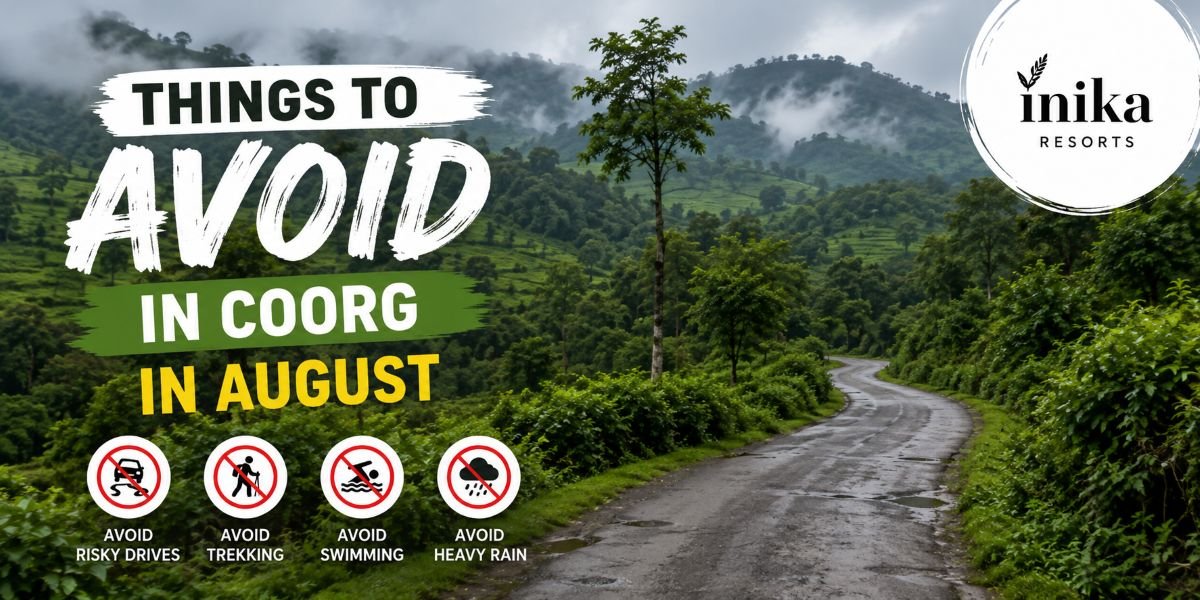
August gives Coorg a completely different character. The coffee country is intensely green, streams are fuller, mist settles over the hills, and even familiar roads can look dramatically different after a spell of rain.
But August is also when travelers need to be more careful. Heavy rain can affect roads, trails, waterfalls and outdoor plans. If you’re visiting Coorg during this month, knowing what to avoid can make the difference between a relaxing monsoon holiday and a frustrating one.
Here are the things I would avoid during an August trip to Coorg.
1. Avoid Planning Every Hour of Your Trip
The biggest mistake is creating a rigid sightseeing schedule.
Rain in Coorg can change your plans quickly. A morning that begins with clear skies can turn wet within a short time, while a rainy afternoon may clear later.
Instead of planning six or seven attractions every day, keep some flexibility.
| Instead of | Try |
|---|---|
| Fixed outdoor schedule | Flexible daily plans |
| 7–8 attractions in one day | 3–4 realistic stops |
| Long-distance sightseeing every day | Group nearby attractions together |
| No backup plan | Keep indoor/local alternatives |
For example, if you planned a waterfall visit in the afternoon and heavy rain arrives, don’t try to force the schedule. Move the activity to another day and enjoy a slower evening.
2. Avoid Driving Fast on Mountain Roads
August is not the month to hurry through Coorg.
Rain can make roads slippery, visibility can drop because of mist, and water may collect on sections of road. Curves that look easy in dry weather require considerably more attention when wet.
This becomes especially important on smaller roads leading toward plantations, viewpoints and forested areas.
A better approach:
- Reduce speed before bends.
- Maintain a larger distance from other vehicles.
- Avoid sudden braking.
- Use headlights when visibility drops.
- Check road conditions before starting longer drives.
- Avoid driving late at night on unfamiliar hill roads.
If you’re renting a car or driving your own vehicle, allow extra travel time rather than trying to maintain normal highway speeds.
3. Avoid Going Too Close to Waterfalls
August can make Coorg’s waterfalls spectacular—but also considerably more dangerous.
Heavy rainfall upstream can increase water volume rapidly. Rocks around waterfalls can become extremely slippery, and water levels may change without much warning.
Avoid:
- Climbing wet rocks.
- Standing directly beneath strong cascades.
- Entering restricted areas.
- Swimming in unfamiliar pools.
- Crossing fast-flowing streams.
- Ignoring barriers or local instructions.
A waterfall can look calm from a distance while conditions around the rocks are unsafe.
The best August experience is often simply enjoying the view from a safe, designated area.
4. Avoid Trekking Without Checking Conditions
August is not automatically a bad month for trekking, but it is a month when conditions matter much more.
Mud, leeches, slippery trails, poor visibility and sudden rain can make a trail considerably harder than expected.
Before starting a trek, check:
- Whether the trail is currently open.
- Weather conditions.
- Local restrictions.
- Expected rainfall.
- Trail difficulty.
- Whether a local guide is required or recommended.
Don’t assume that because a trail was easy during your previous visit, it will feel the same in August.
5. Avoid Wearing the Wrong Shoes
This sounds simple, but it can seriously affect your trip.
Open sandals and smooth-soled casual shoes are not ideal for wet Coorg roads and trails.
Choose footwear with:
- Good grip
- Comfortable support
- Water resistance
- Secure straps or laces
If you’re planning walks through plantations or nature trails, carry an additional pair of footwear so that one wet pair doesn’t ruin the rest of your trip.
6. Avoid Treating Monsoon Forecasts as Exact Predictions
Weather apps are useful, but don’t interpret a forecast of rain as meaning that it will rain continuously all day.
Similarly, don’t assume that a few hours of sunshine mean the weather will remain dry.
Coorg’s August weather can change quickly.
A practical approach is to check the forecast shortly before leaving for a particular attraction and ask locally about road and weather conditions when necessary.
This is particularly useful for remote attractions where a long drive can become inconvenient if conditions deteriorate.
7. Avoid Leaving Without Rain Protection
Even if the morning looks completely clear, carry basic rain protection.
A compact rain jacket is generally more practical than relying entirely on an umbrella, particularly if you’re walking through plantations or sightseeing in exposed areas.
August essentials
| Item | Why it helps |
|---|---|
| Lightweight rain jacket | Sudden showers |
| Waterproof bag cover | Protects electronics |
| Quick-dry clothes | Useful after getting wet |
| Extra socks | Keeps feet comfortable |
| Small towel | Unexpected rain |
| Waterproof phone pouch | Protects your phone |
| Insect repellent | Useful around vegetation |
8. Avoid Packing Clothes That Take Forever to Dry
Heavy cotton clothes can become uncomfortable during a wet holiday.
Instead, pack lightweight and quick-drying clothing. Carry enough changes so that you don’t have to depend on drying everything overnight.
For longer stays, this small adjustment can make the trip noticeably more comfortable.
9. Avoid Ignoring Leeches in Plantation and Forest Areas
Leeches are a normal part of wet forest and plantation environments. Their presence doesn’t mean a place is unsafe, but travelers should be prepared.
If you’re walking through wet vegetation, wear suitable covered footwear and check your shoes and clothing afterward.
Don’t let the possibility of leeches stop you from experiencing Coorg’s plantations; simply prepare for the environment you’re entering.
10. Avoid Overpacking Outdoor Activities
August is better suited to a flexible monsoon itinerary than an activity-packed holiday.
Instead of planning several outdoor experiences every day, leave some breathing room.
For example:
Morning: sightseeing if weather permits
Afternoon: plantation experience or relaxed local exploration
Evening: return to your stay and enjoy the surroundings
This works particularly well for travelers staying somewhere surrounded by nature. At a plantation property such as INIKA Resorts, for example, you can make the stay itself part of the monsoon experience rather than treating accommodation simply as a place to sleep.
11. Avoid Assuming Every Attraction Will Have Normal Conditions
Rain can affect opening conditions, access roads and visitor movement.
Before leaving for a particular attraction, verify:
- Whether it is open.
- Whether the approach road is accessible.
- Whether restrictions are currently in place.
- Whether parking is available.
- Whether heavy rain has affected access.
This is especially important for waterfalls, trekking areas and forest destinations.
12. Avoid Littering During the Monsoon
Coorg looks exceptionally beautiful in August, but heavy rain doesn’t make litter disappear.
Plastic wrappers and bottles can enter streams and drainage channels, eventually affecting the same landscapes visitors come to enjoy.
Carry a small waste bag in your vehicle or backpack and take your waste back with you if a proper disposal facility isn’t available.
13. Avoid Underestimating Travel Time
One of the most common August mistakes is calculating journeys using dry-weather driving times.
A route that normally takes an hour may take longer because of:
- Rain
- Slow traffic
- Mist
- Wet roads
- Temporary waterlogging
- Road maintenance
Build a buffer into your itinerary. Arriving slightly later is much better than rushing through difficult conditions.
A Simple August Rule for Coorg
The best way to approach Coorg in August is to slow down and adapt.
Don’t fight the weather. Don’t take unnecessary risks for a photograph. Don’t try to complete every attraction on your list.
Instead, leave room for rain, keep outdoor plans flexible, use safe viewpoints and trails, and give yourself enough time between destinations.
August can be one of the most atmospheric times to experience Coorg—but the trip is much more enjoyable when you respect the monsoon rather than trying to travel as if it were a dry season.